Mathematics
How to Stop Making Careless Mistakes in Mathematics
BAMIDELE, KAYODE · 7 September 2026

Have you ever solved a mathematics question, checked the answer, and thought:
“I actually knew how to do this. How did I get it wrong?”
You're not alone.
Many students make what are commonly called careless maths mistakes. These aren't necessarily caused by a lack of mathematical ability. Sometimes the student understands the topic but loses a negative sign, copies a number incorrectly, rushes through the question, uses the wrong operation, or simply forgets to check the final answer.
The good news is that many of these mistakes can be reduced.
The key is to develop better mathematical habits.
In this article, we'll look at 10 common causes of careless maths mistakes and practical ways to avoid them.
1. Why Do Students Make Careless Maths Mistakes?
Mathematics requires more than knowing formulas and performing calculations. You also need to read carefully, think logically, follow the correct sequence of steps, and check your work.
Careless mistakes often happen because of:
Rushing through questions Misreading instructions Doing too much calculation mentally Losing negative signs Copying numbers incorrectly Forgetting mathematical rules Skipping important steps Failing to check the answer Becoming distracted Not understanding where previous mistakes came from
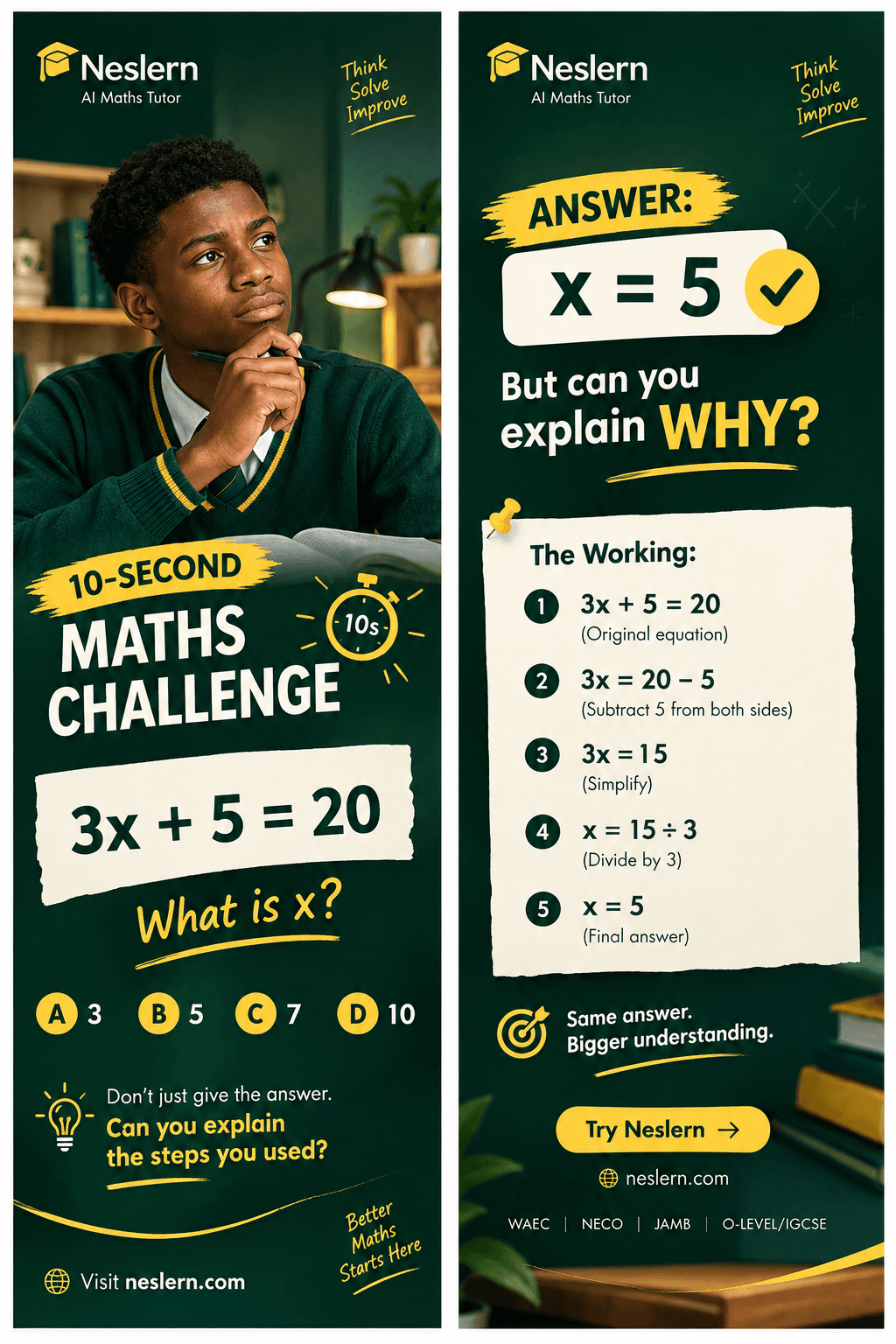
For example, consider:
3x + 5 = 20
A student may correctly subtract 5:
3x = 15
But then incorrectly write:
x = 15
instead of dividing by 3:
x = 5
The problem isn't necessarily that the student doesn't understand algebra. They may simply have skipped a step.
That's why showing your working matters.
2. Don't Rush the Question
One of the easiest ways to make a careless maths mistake is to rush.
You see a question that looks familiar and immediately start calculating.
But familiar-looking questions can still contain important details.
Before calculating, take a few seconds to ask:
What exactly is the question asking me to find?
For example:
A bag contains 8 red balls and 5 blue balls. How many balls are in the bag altogether?
The operation is straightforward:
8 + 5 = 13
But if you rush through the question, you could easily miss a word such as “altogether” or misread one of the numbers.
A useful habit is:
Read → Think → Solve → Check
Don't allow the desire to finish quickly to become more important than getting the question right.
3. Read Every Instruction Carefully
Sometimes the mathematics isn't the difficult part.
The instruction is.
A question may ask you to:
Calculate Simplify Factorize Solve Find the value Express in a particular form Give your answer to a specified number of decimal places Give your answer in a particular unit
These instructions are not interchangeable.
For example, if a question says:
Give your answer correct to 2 decimal places.
Writing 3.1 when the correct answer is 3.14 would not satisfy the instruction.
Before solving a question, identify the important instruction words.
Ask:
“What exactly does this question want from me?”
That small habit can prevent unnecessary mistakes.
4. Always Show Your Working
One of the most useful habits in mathematics is showing your working.
Consider:
2x + 6 = 14
Instead of jumping straight to:
x = 4
write:
2x + 6 = 14
Subtract 6 from both sides:
2x = 8
Divide both sides by 2:
x = 4
Now you can see exactly how you arrived at the answer.
Showing your working has several advantages.
It can help you:
Organize your thoughts Find mistakes Remember the method Understand difficult questions Review your work later Explain your reasoning to someone else
More importantly, if you make a mistake, your working can help you identify where the mistake happened.
5. Watch Out for Negative Signs
Negative signs may look small, but they can completely change an answer.
For example:
7 - 10 = -3
A student who accidentally ignores the negative sign might write 3.
Similarly:
-4 × 3 = -12
and
-4 × -3 = 12
The signs matter.
Whenever you are working with negative numbers, slow down and pay particular attention to:
+ and −
A simple checking habit can help:
“Have I copied and carried the signs correctly?”
This is especially important when working through long algebraic calculations.
6. Check Your Calculations
Even when your method is correct, an arithmetic error can give you the wrong final answer.
For example:
27 × 4
You may know that the method is multiplication but accidentally calculate:
27 × 4 = 98
The correct answer is:
27 × 4 = 108
The mathematical method was fine. The calculation was the problem.
Whenever possible, check important calculations.
You can sometimes use an alternative method.
For example:
27 × 4
can be viewed as:
20 × 4 + 7 × 4
= 80 + 28
= 108
If both methods give the same result, you have more confidence in your calculation.
7. Use the Correct Order of Operations
When a mathematical expression contains several operations, you need to follow the appropriate order.
Consider:
5 + 5 × 2
A common mistake is to calculate from left to right:
5 + 5 = 10
then:
10 × 2 = 20
But multiplication should be performed before addition:
5 × 2 = 10
Then:
5 + 10 = 15
Therefore:
5 + 5 × 2 = 15
The lesson is simple:
Don't rush into the first operation you see.
Look at the entire expression and determine which operation should come first.
8. Check Whether Your Answer Makes Sense
After solving a question, don't immediately move to the next one.
Take a moment to ask:
“Does my answer make sense?”
Suppose a question asks you to calculate:
25% of 80
You calculate and get:
200
Something is clearly wrong.
You know that 25% is one-quarter, so:
80 ÷ 4 = 20
Therefore:
25% of 80 = 20
This type of estimation and logical checking can catch mistakes before you submit your work.
For word problems, also think about whether your answer is realistic.
If you're calculating the number of students in a classroom and get -12, that's a clear warning sign.
9. Practise Similar Questions
Understanding a concept once doesn't necessarily mean you've mastered it.
Practice helps you recognize patterns and apply mathematical methods correctly.
For example, if you're learning simultaneous equations, don't solve only one question.
Try several questions with different numbers and different forms.
You might discover that you understand the first example but struggle when the question is presented differently.
That's valuable information.
It tells you what you still need to practise.
A good practice cycle is:
Learn → Practise → Make mistakes → Understand the mistakes → Practise again
Don't be afraid of getting questions wrong during practice.
A mistake can show you exactly what you need to improve.
10. Learn From Mistakes Instead of Hiding Them
Getting a question wrong isn't necessarily a bad thing.
Not understanding why you got it wrong is the bigger problem.
When you make a mistake, don't simply erase it and move on.
Ask:
What happened?
Did I:
Misread the question? Copy a number incorrectly? Forget a rule? Lose a negative sign? Use the wrong formula? Make an arithmetic error? Skip a step? Misunderstand the concept?
For example, if you repeatedly forget negative signs, you now know something specific that you need to work on.
Instead of saying:
“I'm bad at maths.”
you can say:
“I need to pay more attention to negative signs.”
That's a much more useful approach to learning.
11. How Can Step-by-Step Solutions Help?
Sometimes the biggest problem isn't getting an answer.
It's understanding how the answer was reached.
Suppose you see:
x = 7
That tells you the result.
But it doesn't necessarily tell you the method.
A step-by-step solution allows you to follow the reasoning.
For example:
3x + 4 = 25
Subtract 4:
3x = 21
Divide by 3:
x = 7
Now you can see the process.
This becomes particularly useful when you're stuck on a question.
Instead of simply looking for the final answer, you can study the steps and ask:
“Where did I get stuck?”
That's a much better way to turn a solution into a learning opportunity.
12. How Neslern Can Support Mathematics Practice
This is where tools such as Neslern can become useful for students.
Neslern is an AI-powered mathematics tutoring platform designed around step-by-step mathematical working.
Instead of focusing only on the final answer, Neslern helps students explore how a mathematics problem is worked through.
Students can use the platform to work through mathematics questions and practise by topic.
Neslern is designed for learners working toward examinations and mathematics study including:
WAEC • NECO • JAMB • O-Level/IGCSE
The important thing is how you use the tool.
Don't simply copy a solution and move on.
Instead:
Read the question yourself. Try to solve it. If you get stuck, use the explanation for guidance. Study the working. Identify where your approach went wrong. Try a similar question yourself.
The goal is not simply to collect answers.
The goal is to understand the mathematics.
A Simple 5-Step Habit for Better Maths
If you want to reduce careless mistakes, try this process whenever you solve a question:
1. READ
Read the entire question carefully.
2. THINK
Identify what you know and what you need to find.
3. SOLVE
Choose the appropriate method and show your working.
4. CHECK
Review your calculations, signs and final answer.
5. LEARN
If you made a mistake, identify exactly where and why.
This may take a little more time initially, but it can help you develop stronger mathematical habits.
Final Thoughts
Careless maths mistakes can be frustrating.
But making mistakes doesn't mean you cannot do mathematics.
Sometimes the solution is not simply to study harder.
It is to develop better habits:
Read carefully. Think before calculating. Show your working. Check your answer. Learn from your mistakes.
And most importantly, don't focus only on whether your answer is correct.
Ask yourself:
“Do I understand how I got there?”
Because when you understand the method, you're better prepared when the numbers change and the next question looks completely different.
Don't just correct your answer. Understand where the mistake happened.
Explore Neslern and practise mathematics step by step at neslern.com.
Log in to react to this post.
Frequently asked questions
Stuck on a maths question right now?
Neslern solves it step by step, written the way a real maths teacher would explain it — free to start, no card required.
Related articles
10 Common Maths Mistakes Students Make and How to Avoid Them